We Looked Into What Makes a Woodworking Plan Actually Complete. Most Don't Qualify.
Affiliate Disclosure: This article about Ted's Woodworking contains affiliate links. If you purchase through our links, we may earn a commission at no additional cost to you. We only recommend products we genuinely believe in. Read our full disclosure.
Mike spent a Saturday afternoon trying to answer a question he'd never thought to ask before.
He'd been woodworking for years. He'd used dozens of plans. Some worked. Most didn't — or didn't fully, stopping at some point before the project was done and leaving him to improvise the rest. He'd always assumed the failure was in himself: some knowledge gap, some technique he hadn't developed, some tool he didn't have.
That Saturday, he decided to look at the plans themselves and see whether they contained what a plan actually needed to contain.
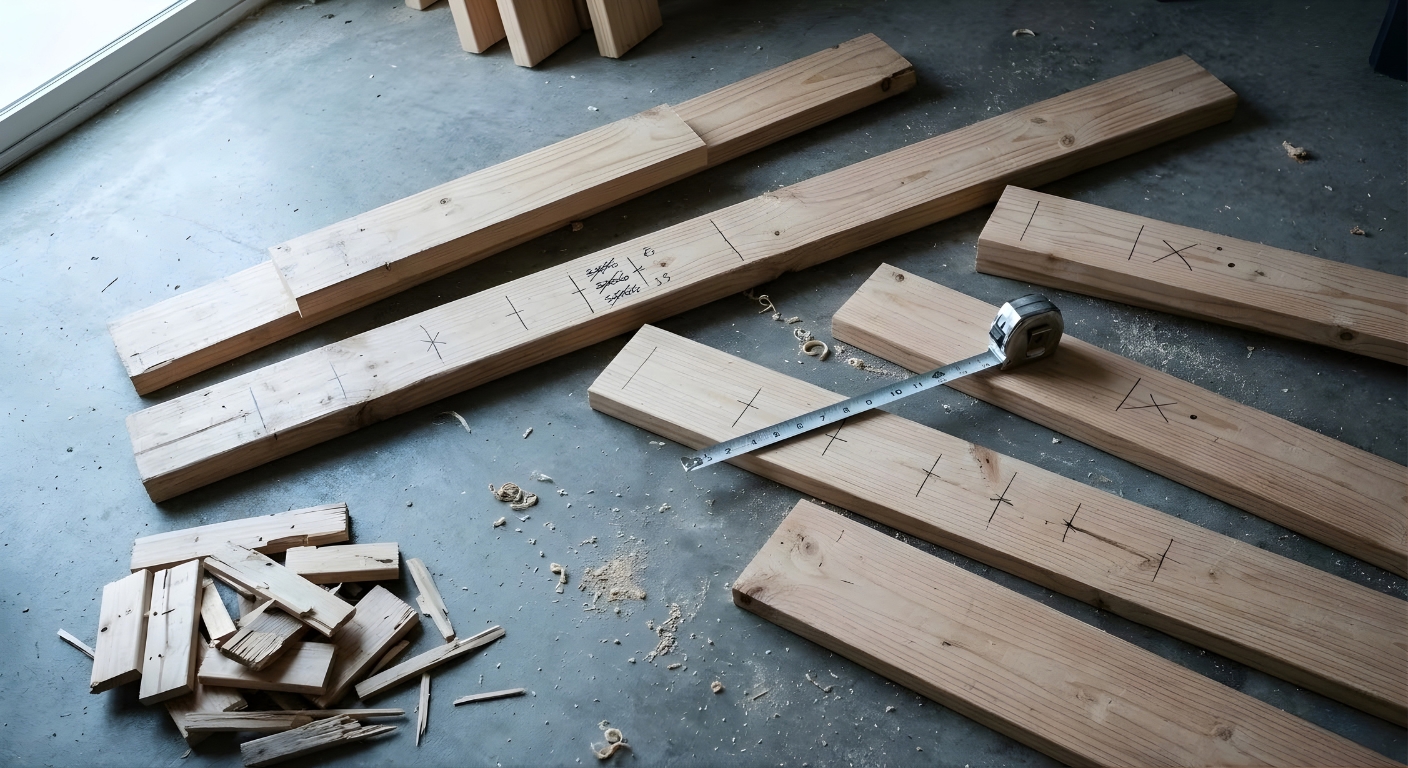
He pulled out three plans he'd used in the past — projects that had stalled or failed. He laid them out and tried to identify, specifically, what each one was missing. What would have made the difference between following these plans to a finished piece and stopping where he did.
The answer, across all three, was the same set of omissions.
"I'd been treating my plan failures as skill failures for years. When I actually looked at what the plans were missing, the skill wasn't the issue at all."
We looked into this formally because Mike's discovery turned out to reflect a consistent gap in how most woodworking plans are written.
What a Complete Plan Actually Needs
We researched the documentation requirements for a woodworking plan to be reliably followable by someone who hasn't built the specific piece before. The criteria that emerged are straightforward, and most freely available plans fail multiple of them.
Verified cut lists with actual dimensions. A cut list that specifies lumber by nominal size — "1x6 at 36 inches" — without accounting for actual dimensions is incomplete. Nominal dimensional lumber sizes differ from actual sizes: a 1x6 measures 3/4 inch by 5-1/2 inches. A plan that doesn't account for this produces pieces that don't fit together at the specified dimensions. A complete plan specifies actual finished dimensions for each piece and accounts for kerf width where precise fitting is required.
Explicit assembly sequence. Many plans describe what to build without specifying the order in which operations need to happen. In practice, the order matters: some joints need to be cut before surfaces are glued, some elements need to be dry-fit before final assembly, some clamping setups constrain what can be worked on simultaneously. A complete plan specifies the sequence explicitly — not just the steps, but the dependencies between them.
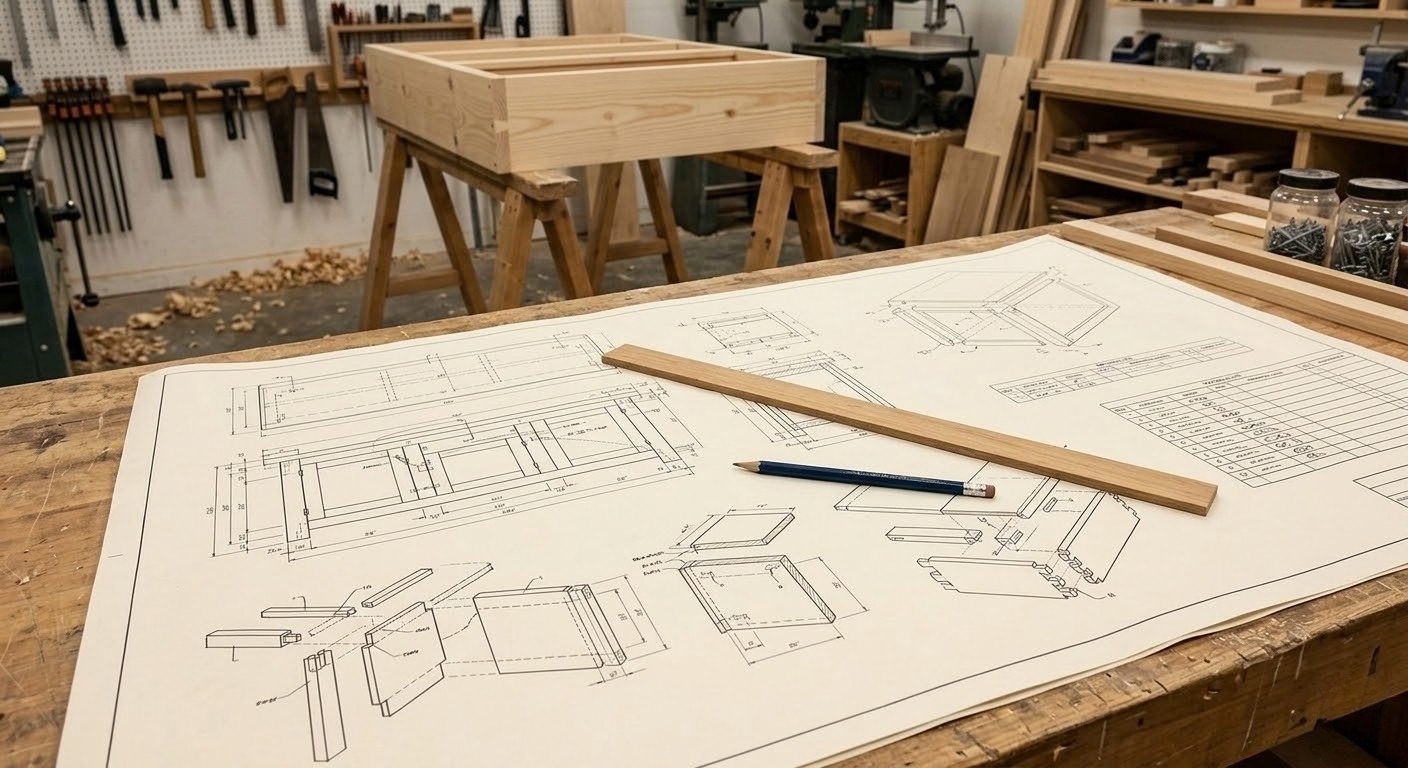
Multi-angle schematics. A diagram of the finished piece from one angle shows what the project should look like. A diagram from multiple angles — front, back, side, exploded view of each joint — shows how it's constructed. The difference is the difference between knowing the destination and knowing the route. A complete plan provides both.
Full hardware specification. A materials list that covers primary lumber without specifying fasteners, brackets, hinges, slides, or finishing materials is incomplete. These items are necessary for the build and their omission requires additional trips to the hardware store and often introduces compatibility problems when substitutions are made without guidance.
Technique documentation for non-standard cuts. When a plan requires a technique that isn't standard — a curved cut, a specific joint geometry, a router operation — the documentation needs to explain how to execute that technique with the tools available to a typical hobbyist workshop. Omitting this leaves the builder to research the technique independently, often finding instructions optimized for different tools or different project contexts.
How Most Plans Fail These Criteria
Free and low-cost woodworking plans fail these criteria for a structural reason: they're written by people who already know how to do what the plan describes.
When you know how to build something, the steps that require knowledge feel obvious. The assembly sequence is automatic because you've internalized it. The technique for the curved cut is familiar. The hardware list is complete because you know what you need. None of this knowledge transfers into the documentation unless you deliberately reconstruct your own ignorance to identify what someone unfamiliar with the project would need to have written out.
That reconstruction is difficult. It requires either extensive experience writing technical documentation or a testing process that uses someone who doesn't know how to build the project as the verification mechanism.
Ted's Woodworking's Approach to These Criteria
We investigated Ted's Woodworking because its testing model directly addresses the documentation gap that produces incomplete plans. Every plan is built by a team that didn't write it, with instructions to flag every point where the documentation falls short — where the sequence is unclear, where the dimensions don't match real materials, where a technique is assumed rather than explained.
The library covers over 16,000 projects and has been built over 25 years through this process. Plans include exact cut lists specifying actual dimensions, assembly sequences written in operational order, multi-angle schematics including exploded joint views, complete hardware lists, and technique documentation for non-standard operations.
The cost of working from incomplete plans accumulates over time in wasted materials and abandoned projects — and the gap between a plan that looks complete and one that actually is can be invisible until you're in the middle of a build.
What We'd Note Before Starting
Ted's Woodworking is a digital library. Plans are downloaded and printed as needed. Lifetime access on a one-time purchase, with new plans added monthly at no additional cost.
The library's volume — 16,000 plans — is navigated through keyword search and category filters. Users with a specific project find it quickly. Users browsing for inspiration benefit from the difficulty and category filters.
This Is For You If…
- You've experienced plan failures and want to understand what was actually missing
- You want a library built to the documentation standards that produce finished results
- You value cut lists verified against actual lumber dimensions rather than nominal specs
- You want assembly sequences written in operational order, not as a list of steps to interpret
This Is NOT For You If…
- You write your own plans from original designs
- You want physical printed materials
- You're looking for a single specific plan
- You need structural or commercial construction documentation
What Mike Uses as a Reference
He kept the three plans he analyzed that Saturday. Not to follow them — to remind himself what he was looking for.
When he evaluates a plan now, he checks it against the same criteria: actual dimensions, full assembly sequence, multi-angle schematics, complete hardware list, technique documentation. He doesn't start a build until the plan passes all five.
Most of what he builds now comes from a library where that check has already been done.
Recommended Resource
16,000 Plans. Every One Built and Tested Before You See It.
The library built to the standards that make a plan actually followable — not just one that looks like it should work.
See the Complete Plan Library →Affiliate link — we earn a commission at no cost to you.